
Town guide / South Manchester and Stockport
Victorian furniture for a Sale villa, terrace or semi
Sale grew quickly once the railway arrived in the mid-nineteenth century, with the Bridgewater Canal already running through it, and many of its streets went up when Victorian furniture was simply new furniture.
i.
The houses
Brooklands and the roads near the canal have substantial Victorian and Edwardian houses with high ceilings and deep bay windows, while elsewhere there are terraces and plenty of interwar semis. A Victorian bookcase or wardrobe that looks right in a villa can overwhelm a 1930s bedroom, so it pays to think about the room before the piece. Original suspended floors plus later central heating is the usual combination, and the heating is the bigger risk to old veneers.
ii.
Victorian furniture in that setting
Victorian furniture was made in great quantity, from heavy mahogany wardrobes to plain pine chests, and its quality varies. Check veneers along edges and drawer fronts for lifting, open every drawer to see that it runs smoothly, and notice whether handles have been changed. Ask Sara for the height of any wardrobe or bookcase with its cornice fitted, since that is the figure that meets your ceiling.
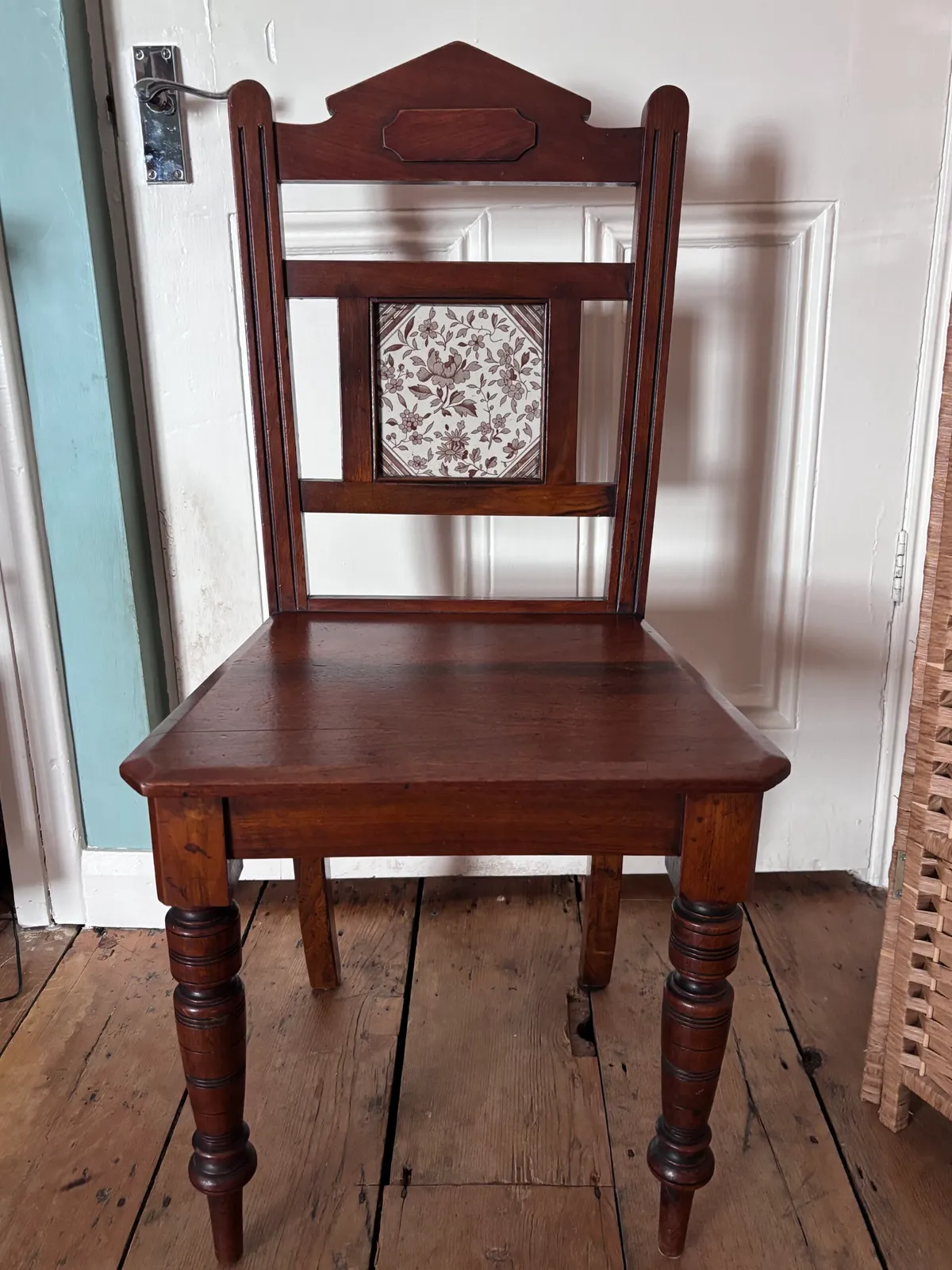
No.06
Hall chair
- Timber
- Hardwood
- Period
- c. 1880 to 1900, as listed
Priced on Creative Caernarfon. Ask Sara whether it is still here.
Photographed in the collection, Plate 06
Victorian Chair with Decorative Tile Back
Aesthetic Movement chair with a floral ceramic tile set into the back, clean geometric lines and turned front legs. Listed in good antique condition with wear consistent with age.
One-off. Ask whether it is still available.
Ask Sara about this pieceiii.
Buying from Caernarfon
Life: Full Colour has no branch in Trafford. From Caernarfon the road runs east along the A55 and then the M56 towards Sale.
Buying works the same way from anywhere: find a piece, ask Sara about it by the enquiry form or on 01286 400155, and buy through Creative Caernarfon.
Visiting and delivery
Life: Full Colour is based at 9 Segontium Terrace, Caernarfon LL55 2PN. Ask Sara whether delivery or viewing is possible for a particular piece.
Victorian furniture listed on Creative Caernarfon
- Victorian Chair with Decorative Tile Back (opens in a new tab)
- Victorian Mahogany Wind-out Dining Table with Eight Chairs (opens in a new tab)
One-off pieces: ask Sara whether a listing is still available.
iv.
Questions for a Sale buyer
Some will, many will not. Victorian wardrobes were often made for taller rooms, and some are too high or deep for later houses. Many come apart into cornice, carcass and plinth, which helps on stairs. Ask Sara for the measurements of each section and compare them with your ceiling height and landing.
Veneers were laid with animal glue, which can fail when wood dries out or gets damp. Central heating and direct sunlight are common causes. Small lifts can often be relaid by a furniture restorer. Look closely at edges and corners in photographs and ask Sara about the veneer before buying.
Pine was widely used for kitchen, bedroom and servants' furniture in the Victorian period, and was often painted originally. Stripped pine suits plainer rooms and kitchens well. Check for splits, earlier worm and replaced knobs, and ask Sara whether a piece has been stripped and how it has been finished since.
Start with the ceiling height and the width of the wall, because a tall Victorian piece with its cornice can need more room than it looks. Measure the narrowest doorway and the stair turn on the route in. Check whether the cornice lifts off, which can lower the height a little.
Usually, since drawers were made for linen and clothes, but bulky folded jumpers may want more depth than a small chest offers. Measure inside the drawer, not just the outside, because drawer sides are often thinner than modern ones. Ask Sara for the inside measurements.
Often, yes. Victorian mahogany is smoother and darker, while Welsh oak is plainer and more rustic, and the contrast can work if one piece leads. Vary the heights and give each piece some wall of its own, so they do not crowd each other.
Much of it was made in quantity for ordinary households, so it was built to be used. Check that joints and drawers are sound, then use it freely. Marks and rings are likely, so treat veneered tops with more care than solid ones, as veneer can lift if it gets wet.
It can be. An old chest or cupboard is well made and can move with you from home to home. Buy one piece you actually need rather than a roomful, and measure first, because old furniture is often bigger than new.
Think about weight, heat and stability. A solid chest may carry a modern set, but it should stand level, and the television's vents need space, as warmth can mark finishes. Cables will need a route that does not mean cutting into an old piece.
If it has come from a cold room, let it acclimatise for a few days before heavy use or waxing. Wood adjusts to warm, dry air slowly, and a sudden change can open a joint or lift a veneer edge. Keep it away from radiators for the first weeks.